 By Dr Phil Osagie
The World Public Summit Africa has issued a powerful call for the continent to claim its place in the global artificial intelligence revolution—and not remain a spectator or simply a user of technologies created elsewhere.
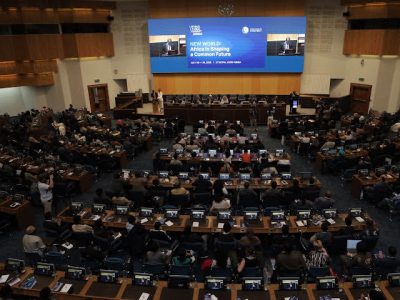
Held at the United Nations Conference Centre in Addis Ababa under the theme “A New World: Africa in Shaping a Shared Future,” the summit brought together more than 700 government leaders, diplomats, business executives, academics, innovators, media professionals and civil society representatives from Africa and around the world.
African governments, universities, technology companies and investors were urged to work together in building indigenous AI capabilities, strengthening digital infrastructure, investing in research and developing solutions tailored to Africa’s realities in agriculture, healthcare, education, financial services, climate resilience, public administration and entrepreneurship.
Delegates warned that while AI promises unprecedented gains in productivity and innovation, Africa risks becoming permanently dependent on foreign technologies unless it develops its own talent, computing capacity, data infrastructure and innovation ecosystems.
Professor Alexander AGEEV, Director General of the International Research Institute of Management Problems (IAMR), and Chairman of the Scientific and Expert Council of the World Peoples Assembly, pointed out that Aftica missed out on the Industrial Revolution , Digital Information Revolution and now it’s about to miss out on the latest AI Revolution.
Ageev said Aftica must move beyond mere consumers of Ai and apply its natural wisdom in rapidly understanding it and adapting AI more creatively to achieve rapid economic development.
Fidel CASTRO-SMIRNOV, Academician of the Cuban Academy of Sciences and professor of the University of Havana said: “Science is the fastest way to gain and retain independence. Ideas, not guns will always be the winners of all wars.”
One of the summit’s landmark sessions—“Information Sovereignty of Africa and the Crisis of Trust in the Media in the Era of Neural Networks”—focused on how Africa can retain control over its digital future while confronting misinformation and declining public trust.
Participants argued that information sovereignty is becoming as strategically important as political and economic sovereignty. They stressed that Africa must own its stories, protect its data, preserve its cultural knowledge and ensure that artificial intelligence strengthens, rather than weakens, democratic institutions and public confidence.
The ethical implications of artificial intelligence and genome editing were also examined under the Global Initiatives of the Scientific and Expert Council of the World Peoples Assembly. Experts debated the ethical boundaries of emerging technologies and warned against the creation of new forms of inequality between nations and civilizations driven by unequal access to advanced technologies.
The Summit emphasized that Africa’s AI future must be built on ethics, transparency and inclusion. They called for governance frameworks that protect privacy, reduce algorithmic bias and respect the continent’s rich cultural diversity, indigenous knowledge systems and linguistic heritage.
Education featured prominently throughout the summit, with participants advocating greater investment in science, technology, engineering and mathematics (STEM), digital literacy, entrepreneurship and AI research. Universities were encouraged to strengthen partnerships with industry to prepare graduates for an AI-powered economy while advancing innovation that addresses African priorities.
It was concluded that Africa’s greatest competitive advantage is its youthful, entrepreneurial and increasingly connected population. With strategic investments in education, innovation, regional collaboration and digital infrastructure, the continent can become not only a participant in the global AI economy but one of its architects.
Hosted in Addis Ababa—the diplomatic capital of Africa and home to the African Union—the World Public Summit concluded with a clear message: the race for artificial intelligence is no longer simply about technology. It is about economic sovereignty, human development and Africa’s ability to shape its own future in the emerging global digital order.
Support the New Americans magazine to continue to serve our community with precise news that affect the new American, immigrant and refugee community. https://paypal.com/donate/?hosted_button_id=8LHFS78NRNJJY&source=url