 By

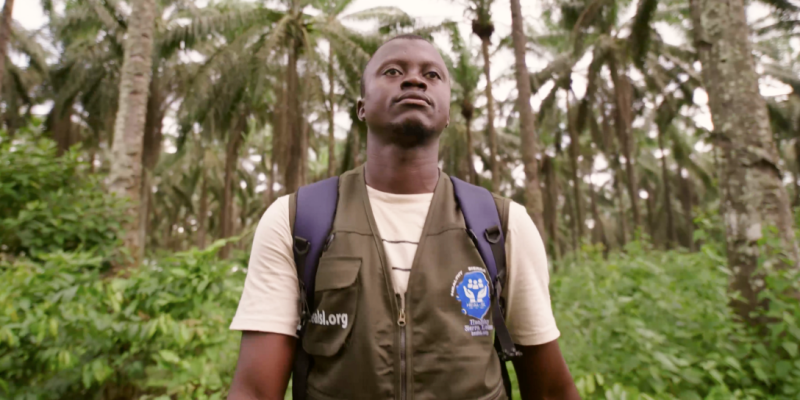
Andrew Moseray walks, rides, and even wades through Sierra Leone to find out why people die. What he learns helps save lives.
In Sierra Leone’s Bonthe District, there’s a village called Segbelleh. During the country’s dry season, when the river levels drop too low for boats, the only way to get there is wading ten miles in knee-high water. On the other side are two houses and about 15 people.
As a field supervisor and master trainer for Healthy Sierra Leone, or HEAL-SL, Andrew Moseray has made that journey. His job is to go door to door, in hundreds of randomly selected communities, and ask families a hard question: Has anyone in this household died? If the answer is yes, his questions keep going. When did the person first get sick? Did they have a fever, a cough, maybe a swollen belly? What medicines did the person get, and what happened next?
Some of those communities are a short drive from Bo, Sierra Leone’s second-largest city, where Andrew lives. Others take nine hours by boat, or a motorbike ride followed by miles walking through mud. Andrew calls himself the “health soldier” of Sierra Leone; after hearing what he does, I think the title fits.
Why counting deaths matters
You can’t fix a problem you don’t understand. But in Africa, most deaths are never recorded, and the ones that are rarely list a cause. Until recently, Sierra Leone was one of those places, so global estimates had to fill the gap with models and projections that were often inaccurate.
That’s why our foundation funded HEAL-SL from its launch in 2019. Its surveyors conduct what’s called a verbal autopsy: They sit with the person closest to someone who died and record their whole story, from their earliest symptoms to their final breaths. Using that information, two physicians then assign a cause of death.
HEAL-SL’s first nationwide round surveyed about 343,000 people across Sierra Leone and recorded more than 8,000 deaths. The data revealed that malaria was a leading cause of death in the country for young children.
In places without reliable death records, verbal autopsies are often the only practical way to learn why people are dying. They give researchers a good first picture—a hypothesis to test—and show them where to look more closely and investigate. Of course, verbal autopsies have limits. A parent can tell a surveyor that their child had a fever, but not necessarily which disease caused it.
In addition to working to make verbal autopsies more accurate, our foundation supports more precise ways of finding out why people die. One example is the minimally invasive autopsies used by CHAMPS, a mortality surveillance network with a site in Sierra Leone. The two approaches work best together: Verbal autopsies can cover a whole country and help experts ask the right questions, and minimally invasive autopsies can help answer them.
“How will this data impact me?”
Early in Andrew’s career, a young man whose wife had just died during childbirth asked him a question he’s never forgotten: “I won’t eat today, and I don’t know if I’ll eat tomorrow. What will you do for me? How will this data impact me?”
He didn’t have a great answer then, he admits. He has a better one now. HEAL-SL’s findings, along with other research, helped show health officials how many of Sierra Leone’s children were dying of malaria. In 2024, with support from Gavi, the Vaccine Alliance, UNICEF, and WHO, the country began vaccinating young children against the disease. Now, when Andrew visits a community, he asks mothers to bring out their children’s clinic cards, points to the malaria vaccine, and tells them that HEAL-SL’s data helped demonstrate it was necessary. Their kids have an extra layer of protection, he explains, because of what other people were willing to share.
His reasons for doing this work are personal. In his teenage years, he wanted to be a doctor. But as he was finishing secondary school, Ebola hit Sierra Leone, and he watched as people reported sick neighbors and family members to the authorities. At first, it looked like a betrayal. But Andrew now understands that they were protecting not just themselves but their communities—which is the essence of public health, the field he decided to pursue instead.
Years later, while Andrew was doing verbal autopsies for CHAMPS, his two-year-old cousin died after spending two months in the hospital with no diagnosis. Only afterward did a minimally invasive autopsy reveal the cause: tuberculosis. Andrew shares that story with families who don’t want to talk. “Evidence-based data is quite important,” he says.
Teaching the next generation
Andrew joined HEAL-SL as a data collector and quickly stood out. He became a team lead, then a trainer, and he has since trained surveyors in Sierra Leone and other West African countries. His wife Isha says his true calling is teaching. Alieu Fatorma, one of the surveyors he trained, says, “He makes it simple.”
Andrew asks every new trainee two questions: Who are you, and what is your mandate? His answers: You are a surveyor. Your job is to listen and record, and you never judge or diagnose. Trust, he says, comes from small things. “We eat what they eat. We sleep where they sleep. If they took off their shoe, we take our own shoe off.”
The HEAL-SL team has a saying: “We count the deaths for the living to live.” I can’t think of a better description of Andrew’s work.
Support the New Americans magazine to continue to serve our community with precise news that affect the new American, immigrant and refugee community. https://paypal.com/donate/?hosted_button_id=8LHFS78NRNJJY&source=url