 By
By Deba Uwadiae and Okon Ekpenyong
City of Columbus, Ohio Mayor Andrew J. Ginther was at the Ecole Kenwood French Immersion School, Shattuck Avenue, Columbus to cast his vote on the final day of 2026 Elections, calling on voters to go out and vote, no matter their choices.
Mayor Ginther entered the polling station at about 10AM and voted at 10.25AM.
“Whoever your choice is, whatever your decision, get out there and vote,” said Mayor Ginther.
‘I really believe your vote is your voice. I think it is important that the people of Columbus in Ohio, in America to get out and make sure their voices are heard.”
“We had a record number in early voting. Across the state, over 1.7 million people voted early. I know it is the biggest midterm early voting in the history here in Franklin County, Ohio. Some said it might even approach Presidential year turnout in the early voting this year.”
“I want to encourage people to come out, make a plan and make sure you bring your ID. A lot of voting locations have changed. Before poeple go to their polling stations, make sure they check their polling locations.
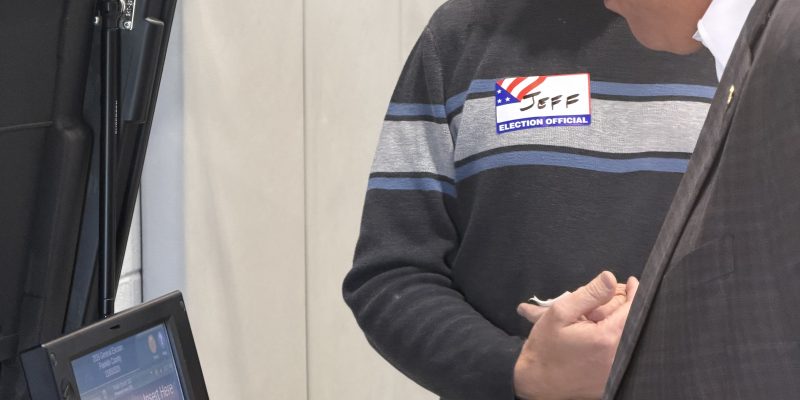
“I want to thank the poll workers. each poll workers, Republican and Democrats, Independent working together to protect our system.
Mayor Ginther hoped to see more turn out, adding that “when more voices are heard, I think government works better. I want to encourage people that whatever their choices are and whatever their party is to get out and vote today.”
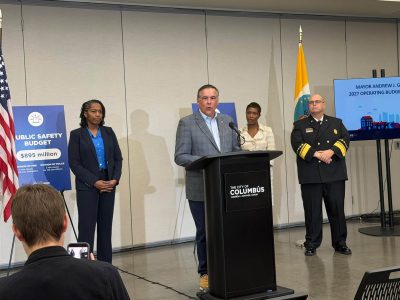
Also, Columbus City Council President Shannon Hardin joined Mayor Ginther in calling for people to come out and vote.
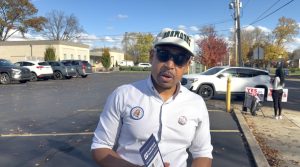
Columbus City Council President Shannon Hardin
“We’ve been out all day, on all sides of town, at voting locations. I think this is my fifth voting location today. And what we are seeing is record turnout—record turnout, certainly for a midterm election. But I personally, and admittedly, have not seen this type of turnout. I mean, in terms of lines and overperforming, since 2012,” said Hardin.
“But what I do not want to at all insinuate is that the job is over. We need everyone—everyone—to get out and vote. The polls close at 7:30. If you can get in line by 7:30, please do. This election is too important to let someone else do it or let someone else vote while you think you can stay home today. If you’re about to get off, please stop by on your way home.”
Meanwhile, as polls close across Ohio at 7:30 p.m., Secretary of State Frank LaRose has reminded Ohioans that Election Night is just the beginning of a thorough, bipartisan process to verify election results.
“Ohioans can have confidence that our election process doesn’t end when the polls close,” said Secretary LaRose.
“While we pride ourselves on delivering 100% of the unofficial result on Election Night, the work continues for our bipartisan election officials as they carefully review the results, account for every eligible ballot, and conduct additional checks before the election is officially certified. Speed and accuracy work hand in hand for the benefit of every Ohioan.”
Under Ohio law, each of the state’s 88 bipartisan county boards of elections follows a series of steps before results become official:
1. Election Night: Reporting Unofficial Results
After polls close, county boards of elections tabulate ballots cast on Election Day and eligible absentee ballots, including early in-person votes and mail ballots. These unofficial results are reported to the Secretary of State’s office and made available to the public at LiveResults.OhioSoS.gov. The first results reported will be the absentee by mail and early, in-person ballots, followed by the Election Day precincts.
2. The Days After Election Day: Reviewing Outstanding Ballots
County election officials review provisional ballots to determine voter eligibility. Voters who need to provide additional identification or correct certain absentee ballot deficiencies have four days after Election Day to do so. Eligible military and overseas absentee ballots received by mail within four days after Election Day are also included in the final count.
3. Official Canvass: Verifying and Certifying Results
Between five and 15 days after Election Day, county boards begin the official canvass, carefully reviewing election records, resolving discrepancies, and counting all remaining eligible ballots. Boards of elections must complete the official canvass and certify their results no later than 21 days after Election Day. County certifications will be reviewed by the Ohio Secretary of State’s office prior to the final statewide certification. Ohio law only allows the Ohio Secretary of State’s office to release results two times: once on Election Night and once following the Official Canvass.
4. Recounts: Reviewing Close Races
The Secretary of State must order an automatic recount for any statewide election when the vote difference between votes cast for the declared winner and loser is less than one-fourth of one percent (0.25 percent) of the total votes cast in the race or issue. (Ohio Election Official Manual, CH. 11 P. 414)
5. Post-Election Audits: An Additional Layer of Verification
County boards conduct post-election audits that include hand-counting selected paper ballots and comparing those totals with the electronically tabulated results. These audits provide an additional independent check of election accuracy. Learn more about how Ohio conducts post-election audits here.
“Ohio’s elections are built on bipartisan accountability, paper ballots, and multiple layers of verification,” added LaRose. “Election Night gives us the initial, unofficial results. The days and weeks that follow confirm that those results are accurate.”
Support the New Americans magazine to continue to serve our community with precise news that affects the new American, immigrant and refugee community. https://paypal.com/donate/? Dr;/.hosted_button_id=8LHFS78NRNJJY&source=url


Screenshot