
 By
By By Governor Mike DeWine, Ohio State
Today, I want to talk about capital punishment. I want to start with my experience with capital punishment.
MY EXPERIENCE WITH CAPITAL PUNISHMENT
As you can imagine, as a former county prosecuting attorney, a member of the Judiciary Committee in the state Senate, a member of the Judiciary Committee in the U.S. House of Representatives, a member of the Judiciary Committee in the U.S. Senate, as Ohio Attorney General, and now as Governor, I have had ample reason to think about this issue for 50 years.
During my time as an assistant prosecutor and then as the elected prosecutor, I prosecuted no death penalty cases (For a significant part of my time in that office, Ohio’s death penalty law had been declared unconstitutional.). However, my time as a prosecutor was very impactful. It was my first opportunity to work with victims of horrific crimes, such as rape and homicide, and to see first-hand how devastating these crimes are to the victims and their families.
In 1980, when I was elected to the Ohio State Senate, Ohio had no death penalty law. When I was appointed to the Judiciary Committee, we quickly started working on a new death penalty law that we hoped would conform to U.S. Supreme Court decisions. I was a co-sponsor of Senate Bill 1, a bill to reinstitute Ohio’s death penalty. As a member of the Judiciary Committee, I participated in the mark-up of the bill and the debate surrounding it.
The State Senate passed the bill on June 30, 1981 — 23 to 10. I voted in favor of it. It was then sent to the House, which passed it the next day by a vote of 71 to 28. Governor Rhodes signed it into law, and it took effect on October 19, 1981. It was a bi-partisan bill. At the time, the Republicans controlled the State Senate, and the Democrats controlled the State House of Representatives.
It may be of interest that in the State Senate version of the capital punishment bill that we passed in 1981, the jury was given the option of choosing life without parole. The House version did not give the jury this option. The House version ultimately prevailed. While a member of the U.S. House of Representatives, I worked on and voted for the Anti-Drug Abuse Act of 1988, which President Ronald Reagan signed into law, that expanded the number of crimes eligible for the federal death penalty.
While a member of the U.S. Senate, I also worked on and voted for the Anti-Terrorism and Effective Death Penalty Act, which President Bill Clinton signed into law in 1996. Among other things, this law attempted to speed up the review of capital punishment cases in federal courts — all in an effort to shorten the lengthy appeals process in these cases. Years later, as Ohio Attorney General, I vigorously carried out my legal obligation to defend our
capital punishment laws and to litigate in court for the executions.
Some examples include the following:
• Getting Ohio’s death penalty protocol reinstated by the Federal Court of Appeals in 2017
(In Re: Ohio Execution Protocol Litigation);
• Getting Ohio’s death penalty restarted after a prior moratorium;
• Defending death penalty convictions in the U.S. Supreme Court (see Jenkins v. Hutton, 2017) and in the Ohio Supreme Court; and
• Seeking and obtaining death penalty indictments and death sentences on multiple occasions by the Special Prosecutions Section under my direction and authority as Ohio Attorney General;
• Further, as part of the Attorney General’s standard practice, I talked with a number of the victims’ family members by phone prior to the execution.
CAPITAL PUNISHMENT AS A DETERRENT?
When I voted for the reinstatement of the death penalty in 1981, I believed that in some cases, capital punishment could serve as a deterrent to keep some people from killing. For me, it was THE moral justification for having a death penalty. In judging whether capital punishment is a deterrent, two things are very important: certainty and swiftness. By certainty, I mean what is the certainty that it will be carried out — that it will actually happen? How likely is it that a murderer will be indicted for a capital offense, convicted of the capital offense, and then actually executed?
By swiftness, we mean how long does it actually take from sentencing to execution. It would seem that if the death penalty were an actual deterrent for some people, it would need to happen swiftly, quickly, and with certainty.
Yet, statistically, the odds of the death penalty actually being carried out are very low, and if it is carried out, it is all but guaranteed that it will take a long time for it to happen.
Let’s examine the issue of swiftness and look at the data to see how long it is taking for executions to be carried out in Ohio.
The best way to see how long it is taking is to look at the last 10 people to be executed and see how long it took from the time of conviction to the time of execution. The elapsed time between sentencing and execution ranged from a low of 14 years to a high of 32 years. For the last 10 people in Ohio, who were sentenced to death and who were actually executed, the AVERAGE (the mean) elapsed time was 21 years. This statistic omits the people who died waiting to be executed. It also omits those whose cases were overturned by a court.
Of the 337 individuals who received a death sentence since 1981, 56 have been executed. In that same time, 41 died of either natural causes or by suicide while on death row. And, according to the Ohio Attorney General’s most recent annual death penalty report, since 1981, a total of 89 death sentences were removed based on “judicial action.” In the Attorney General’s 2024 annual report, he explains what he means by judicial action. He says that “most were removed because of legal errors, such as ineffective assistance of counsel, Brady violations, juror errors, or appellate determinations that the aggravating circumstances of the crime did not outweigh the mitigating factors beyond a reasonable doubt.”
Excluding the last seven-plus years, we now have four decades of experience with the death penalty in Ohio. Ohio Attorneys General for many decades have had specialized lawyers who work diligently and exclusively on these cases. They do everything they can to speed up the process. Despite their best efforts and the work of Congress to speed things along, we still have
in Ohio an extremely long waiting period between sentencing and execution.
Further, these long delays have occurred in spite of the best efforts of the law enforcement departments that investigated the cases, the prosecutors who prosecuted the cases, and the judges and the juries who decided the cases.
There is no prospect that these long delays will be substantially changed in the future.
Ohio is not an outlier in this regard. Ohio ranks in the middle of the states in the average number of years between sentencing and execution. This is clearly not a problem unique to Ohio. With a more than two-decade-long wait time, the threat of the death penalty today is simply NOT a deterrent.
The day I became Governor on January 14, 2019, U.S. Magistrate Judge Michael R. Merz issued a decision calling into question Ohio’s death penalty protocol as inhumane. In response to that decision, it eventually
became clear to me, that operationally under current Ohio law, the State of Ohio could not obtain the drugs needed to carry out an execution without risking pharmaceutical companies refusing to supply therapeutic
drugs to the State of Ohio — a risk I was not and am not willing to take.
THE CERTAINTY OF THE DEATH PENALTY BEING APPLIED PLUS CHARTS
Let’s now look at the lack of certainty in whether people sentenced to death are ever executed. Let’s look at this since the death penalty’s reinstatement in 1981.
Let’s turn to this chart.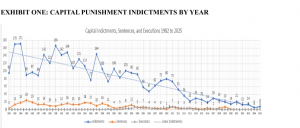
EXHIBIT ONE: CAPITAL PUNISHMENT INDICTMENTS BY YEAR
This chart shows how often people have been indicted for the death penalty per year. As you can see, there has been a dramatic drop over the last four decades in the number of people indicted each year. The blue line shows indictments, the red line shows convictions, and the gray line shows actual executions. Now, let’s turn to how often the death penalty was actually handed down in those cases.
EXHIBITS TWO AND THREE: DEATH SENTENCES BY YEAR
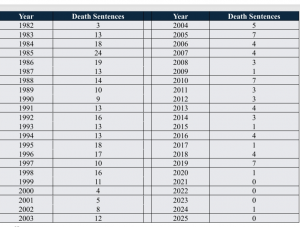
 These charts show the number of death penalty sentences from 1982 to the present.
Even excluding the last seven-plus years, since its inception in October 1981, the number of capital crime convictions has steadily gone down decade after decade. After the death penalty was reinstated on October 19, 1981, counting the first year as 1982, through the remainder of the decade, Ohio averaged 14.25 death penalty sentences each year.
In the 1990’s, we averaged 13.6 death penalty sentences per year.
Year Death Sentences Year Death Sentences
1982 3 2004 5
1983 13 2005 7
1984 18 2006 4
1985 24 2007 4
1986 19 2008 3
1987 13 2009 1
1988 14 2010 7
1989 10 2011 3
1990 9 2012 3
1991 13 2013 4
1992 16 2014 3
1993 13 2015 1
1994 13 2016 4
1995 18 2017 1
1996 17 2018 4
1997 10 2019 7
1998 16 2020 1
1999 11 2021 0
2000 4 2022 0
2001 5 2023 0
2002 8 2024 1
2003 12 2025 0
In the 2000’s, we averaged a little over five (5.3) death penalty sentences per year.
In the 2010’s, we averaged fewer than four (3.7) death penalty sentences per year.
And, in the six years of the 2020’s, we have only had two people sentenced to death.
Please note that in 1995, juries were given the option of life without parole. The first full year that was in effect was 1996.
Let’s look again at the bar graph to show the frequency of the death penalty being handed down per year since its reinstitution in 1982. It is clear from this data that the certainty of the death penalty being applied has steadily gone down over the years. The odds of a murderer being indicted for a capital offense are dramatically less today, and even if actually indicted for a capital offense, the odds of them being sentenced to death are even more remote.
Let’s again look at just those who have been sentenced to death. Of the 337 people sentenced to death:
• 41 died of either natural causes or by suicide;
• 89 were taken off death row by the courts; and
• Only 56 have been executed.
So, even if the murderer is caught, indicted, convicted, and sentenced to death, the odds are still pretty good they are not going to be executed.
And so, with the dramatic drop in people being executed, and the over two-decade wait time for those who are executed, it is hard to make the case for the death penalty being a deterrent.
FORMER DRC DIRECTOR REGINALD WILKINSON ON THE DEATH PENALTY AS A DETERRENT
Former Department of Rehabilitation and Corrections (DRC) Director Reginald Wilkinson served from 1991 until 20062. During that time, he supervised the execution of 20 men. He has written the following about deterrence:
“The claim the death penalty is NOT a deterrent to crime, particularly murder, is supported by a significant body of research and analysis. Many studies, including a report from the National Research Council, have concluded that there is no reliable evidence that the death penalty reduces crime rates more effectively than other forms of punishment.”
Directors of DRC – Four Ohioans have presided over executions since they were re-instituted in 1982. Three have stated their opposition to the death penalty. Once has expressed his support.
CAPITAL PUNISHMENT AND VICTIMS’ FAMILIES
Now, let me turn to a few other things I wish to discuss.
One cannot discuss capital punishment without thinking of the victims’ families. I do not pretend to even be able to imagine how the family of a murder victim feels. However, we do know that these crimes are horrendous and must be gut-wrenching for the victims’ families. The murderers have permanently taken away from them their loved one. The recitation of the facts of the crime must bring about for all Ohioans horror and disgust and great anger. We know anecdotally that many of the victims’ family members want to see the convicted killer executed.
We also know that some family members of victims do not want to see an execution. Some of them have expressed their belief that the victim would not have wanted to have the execution take place. Others have said they do not want the execution for religious reasons. Each victim’s family members react differently. One feeling, however, that seems to be universally held by victims’ families is that the long, long wait to see if the death penalty is carried out is frustrating and very hurtful for these families.
THE PEOPLE WE TASK WITH CARRYING OUT OUR EXECUTIONS
We also cannot talk about capital punishment without talking about those we task with carrying it out. While it is true they are “volunteers,” we still must be mindful of the impact preparations for, and the carrying out of executions have on them. They are the forgotten people — but they are real people. They are our fellow Ohioans.
Gary Mohr served as the Director of the Department of Rehabilitation and Corrections from 2011 until 2018. During that time, he supervised 15 executions. He summarizes the toll on the staff in this one sentence: “The heaviness felt by the execution team and by the support staff is indescribable.”
Mohr points out that there are many people involved in preparing for, practicing for, and carrying out an execution. Mohr describes the first group of staff this way:
“The first group of staff dedicated to the execution process are those staff that are assigned each day to supervise, feed, address the needs of those on death row…. Staff include correctional security staff, nurses, case managers, chaplains, and facility supervisors.”
Mohr points out that many of these staff members see and supervise these death row inmates daily and for many years and that some of the people closest to the execution process believe that we are not executing the worst of the worst. Again, according to Mohr: “As the death row inmates were taken from death row to be transferred to Southern Ohio Correctional Facility the day before the execution, these staff would tell me about the positive things they observed (the death row inmates doing), like teaching other death
row inmates to read or talking other inmates through family crisis.
Staff would ask me, ‘Why them?’ And how is it fair that these inmates were to be executed while others who have killed in prison or killed multiple people or law enforcement and pose a chronic threat to staff and security are not [executed]?” Then there is the execution team, as well as all the dozens of support staff who are needed. Before the execution, the execution team must practice. During Mohr’s time as Director of DRC, the federal judge required four practices.
Listen again to Mohr:
“…a team member served in the role of the person being executed. That person experienced everything the condemned would experience, except for inserting the needles into the vein. That person experienced being secured in the cell, being walked to the death chamber by the team, lying [on] the gurney with their body strapped to the gurney, both arms being strapped to the boards next to the gurney, and laying there for the entire time it would take to complete the protocol.”
Mohr continues:
“On my first execution, I played (it was not play) the role of the condemned. As the process concluded, the team called for the medical staff to respond as I was experiencing extreme anxiety symptoms. Other team members in that role had similar experiences.”
After the actual execution, the execution team is still not finished. Some may be called into federal court to justify how they carried out the execution. According again to Director Mohr:
“As intense as each execution was, the execution team members had to be prepared for their testimony for hours prior to federal court hearings. Preparing to testify brought back all the feelings associated with ending a person’s life.”
The former Director continues, “These staff, carrying out one of the most challenging public service responsibilities, were given little respect by opposing counsel attempting to discredit their work.”
CONCLUSION
It is clear that the death penalty is being handed down much less frequently than it was when it was first passed in 1981. In fact, the decline has been steady in each decade. Further, the wait time between sentencing and execution (for those who don’t die first or have a court intervene for them) has remained very, very long, and with no indication at all that that will change.
In summary, each decade that the death penalty has been in effect, the chances of a murderer getting executed get more and more remote.
The conclusion I draw from all of this is that it is today impossible to make the case that the death penalty is a deterrent.
I no longer believe the death penalty is a deterrent to murder.
The moral justification I had for voting for the death penalty simply no longer exists.
POSTSCRIPT
For the State to take a human life, there must be evidence that in doing so, it will help protect the public — that the threat of that action will deter someone from committing murder. For the reasons stated above, I do not believe that argument can today be made. Nor do I believe that there is any chance in the future the facts I have cited to support that belief will change.
Therefore, I believe Ohio should abolish the death penalty.
The Legislature can take this action, and I believe they should take this action. But, if the Legislature does not want to make that decision, they can leave it up to a vote of the people of the State of Ohio. Throughout my career, I have always stated that the most important way to protect the public is to lock up violent criminals and to keep them out of society. That is a proven way of saving lives and protecting our citizens.
Our money and energies are much better spent focusing on keeping these repeat violent offenders out of society, than focusing on the death penalty. Any decision to officially end the death penalty in Ohio cannot change the horror and the anger we feel in regard to these murderers nor the deep sorrow we feel for the victims and for their families.
We cannot sanitize this discussion. These murderers ended the life of a precious human being. These murderers have changed the lives of the surviving family members forever. Their lives will never be the same.
Support the New Americans magazine to continue to serve our community with precise news that affect the new American, immigrant and refugee community. https://paypal.com/donate/?hosted_button_id=8LHFS78NRNJJY&source=url