 By
By By Okon Ekpenyong
Some visitors come to the Columbus Serbian Festival for its traditional food, music, dancing, and the chance to experience another culture. But sit at a table long enough with members of Columbus’ Serbian American community, and a much larger story begins to unfold. It is a story shaped by mines, steel mills, family businesses, migration, college, faith, community, and the Orthodox Church.
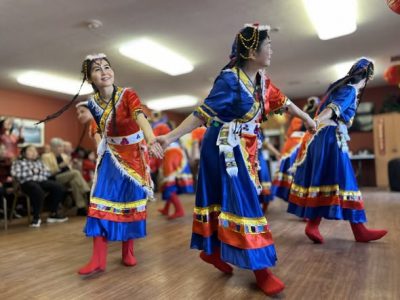
The two-day festival held September 18 and 19, 2026, at St. Stevan of Dechani Serbian Orthodox Church on North Cassady Avenue, Columbus, Ohio features Serbian food, live music, kolo dancing, and church tours.
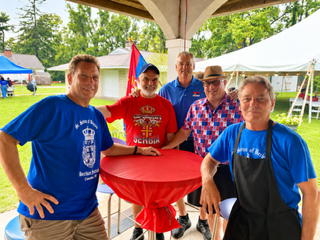
At the festival, five Serbian American men shared stories that stretched far beyond the celebration itself. Their experiences offered a glimpse into how Serbian families established themselves in the United States, followed jobs across the country, and adapted as later generations found new opportunities.
For many earlier Serbian American families, work meant blue-collar industries. One longtime organizer of the festival said his father and six uncles followed their father into mill work. On his mother’s side, his grandfather worked as a machinist before moving into the dry-cleaning business.
By the next generation, expectations were changing. “My generation was probably the first that went to college,” one longtime festival organizer said.
One of the gentlemen said that his father eventually owned three dry-cleaning plants and gave his four sons a choice: enter the family business or pursue higher education. Two chose college, while two entered the plants. One attended Brown University, while the other attended Miami University. Describing those different paths as “situational and opportunistic.”
His family’s story fits a broader pattern in Serbian American history in the United States. According to the Library of Congress’ Serbian and Montenegrin American research guide, Serbian immigration remained high into the first two decades of the 20th century, peaking in 1907. Many newcomers settled in industrial centers such as Pittsburgh, Cleveland, and Chicago and entered physically demanding jobs in heavy industry and mining.
That industrial connection was especially visible around Chicago. According to the Encyclopedia of Chicago History, Serbian immigrants settled heavily in Chicago’s Southeast Side steel district, Joliet and Gary, Indiana, and many Serbian men earned their living in steel mills.
Regions like Chicago and Northwest Indiana, Pittsburgh, Cleveland, Toledo, Akron, Canton, and Milwaukee are where the Serbian communities took root,” the men described. One summarized the pattern simply: “Anywhere there was a steel mill.”
Earlier settlers made their living in coal, fabrication, rubber, and manufacturing. Those industries provided jobs, but they also influenced where families settled and where churches and community organizations developed.
When jobs disappeared, or industries shifted, families often followed opportunity elsewhere. “We had to move. We had to go to California, go to Milwaukee. I had to go wherever the jobs were,” one man recalled.
That movement eventually brought some families to Columbus through work, education, marriage, and family ties. One longtime member of the local Serbian community said he arrived in Columbus in 1974 after graduating from college. Over time, families bought property, raised children, and established roots in Central Ohio.
The Serbian American story also unfolded through different waves of immigration. According to the Library of Congress, Serbian immigration dropped after U.S. quota restrictions following World War 1. Serbian communities nevertheless continued developing through Orthodox parishes, cultural organizations, and successive generations.
According to WorldAtlas, Serbia was internationally recognized as an independent state in 1878 and later became part of Yugoslavia after World War 1. The modern Republic of Serbia dates to 2006, and it is part of Southeastern Europe.
The men at the festival also recalled later arrivals following World War II and another influx connected to the breakup of Yugoslavia in the 1990s. Their recollections, passed down by the elders, help explain why Serbian American identity can look different from one family to another.
Some described themselves as fourth- or fifth-generation Americans. Others spoke about families with much more recent ties to Serbia and the former Yugoslavia. Through those changes, one institution repeatedly emerged as a central link between generations.
Asked what has helped preserve Serbian identity in America, one of them responded immediately: “First and foremost, the church, the Orthodox Church.” That role is visible at St. Stevan of Dechani itself.
According to the Columbus Serbian Festival website, St. Stevan of Dechani Serbian Orthodox Church is part of the Serbian Orthodox Diocese of Eastern America under Bishop Irinej. The church says most parishioners are Serbian or Serbian-speaking, while its congregation also includes American-born English-speaking Orthodox Christians and people with Russian, Romanian, Greek, Ukrainian, and Bulgarian backgrounds.
Services are conducted in Church Slavonic, Serbian, and English, and the parish says it welcomes Orthodox Christians and those interested in learning about Orthodoxy. That makes the church more than simply a festival venue. It is also a place where language, worship, and community life meet.
During the festival, visitors can see that role firsthand through guided church tours. The festival website lists tours at 2 and 6 p.m. on Saturday and describes them as an opportunity to learn more about the Orthodox faith.
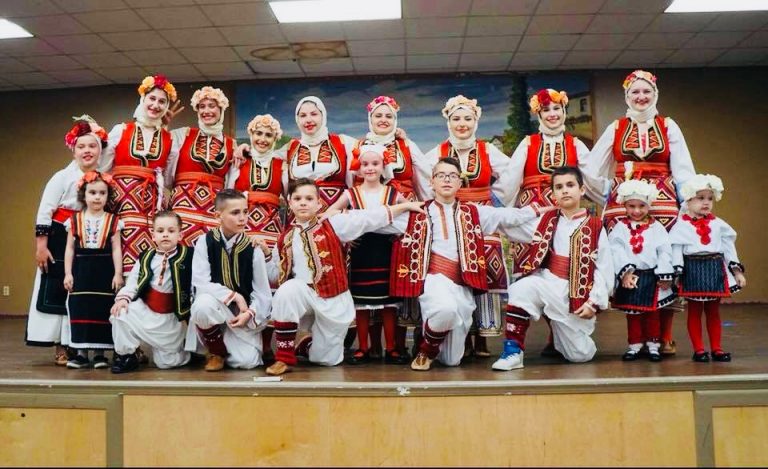
The men also discussed organizations beyond the local church, including the Serb National Federation, Serbian clubs, folk-dance groups and sports organizations that have helped connect Serbian families across cities and generations.
One put it this way: “The community itself” helps keep the identity alive. The importance of the church stretches back to some of the earliest Serbian communities in the United States.
According to the Serbian Orthodox Church in North, Central and South America, the first large wave of Serbian Orthodox immigrants arrived in the late 19th and early 20th centuries. Early parishes developed in mining and industrial areas in states including Pennsylvania, Ohio, Michigan, Illinois, and Indiana.
One of the earliest was in Jackson, California. According to St. Sava Serbian Orthodox Church, miners from Herzegovina, Montenegro, and the Bay of Kotor built the church in 1894 while working in the nearby Kennedy and Argonaut gold mines. “The parish identifies itself as the first Serbian Orthodox parish in North America and the Western Hemisphere. ”
That history came alive when the men were describing the Serbian community in Columbus: people found work, settled near one another, and built institutions that helped preserve faith and community. But not every tradition lives inside a church building.
One of the strongest examples discussed at the festival was Slava, the Serbian Orthodox family tradition honoring a patron saint. When asked to explain what Slava meant to his family, one attendee said: “I’d like to say it’s a party, but it’s not. It’s a remembrance of the day that your family accepted Christianity.” That was his family’s explanation of the tradition.
He described homes staying open throughout the day as friends, relatives, and neighbors came and went. People did not necessarily need formal invitations. They knew which family was celebrating and could stop by to eat, talk, and spend time together. “You came, and you went, and they came, and they went,” he said.
UNESCO describes Slava more broadly as an Orthodox Christian family celebration in Serbia honoring a patron saint. The observance includes prayer and a feast shared with relatives, neighbors, and friends, and families pass the tradition down. UNESCO inscribed Slava on its Representative List of the Intangible Cultural Heritage of Humanity in 2014.
For the men at the festival, culture was not only about formal religious traditions. It could also be something as simple as coffee. One attendee described café culture this way:
“You got ten bucks in your pocket? You got enough for a cup of coffee? Go sit at the café for six, seven hours.”
The point, he explained, was not really the coffee. It was having time to sit, talk, and put everyday problems aside for a while. The same idea surfaced when we asked the men what outsiders might overlook about Serbian culture. One answered with a single word: “Passion.” Then another added: “We are very, very passionate.”
He described that passion as something expressed through food, love, music, faith, and strongly held viewpoints. Those details are difficult to learn from an event calendar. Those details come from sitting at the table.
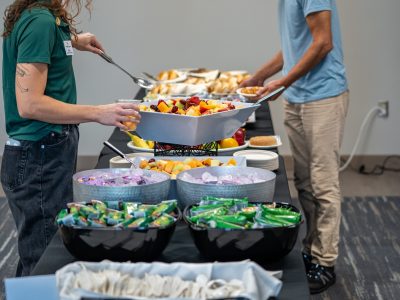
The men also described food as a major part of Serbian culture, especially roasted lamb and pork cooked slowly over an open fire. One attendee even showed a video of several whole pigs roasting on spits — a traditional, from-scratch style of cooking that remains a big part of Serbian celebrations alongside dishes such as ćevapi, sarma, burek and gibanica.
But beyond the food, the people behind the celebration carry stories of miners, machinists, steelworkers, factory employees, family-business owners, and parents who later encouraged their children to attend college. The industries changed. Families moved. New generations grew up in America.
But the church, family traditions, and habit of gathering continued to provide a connection. Some people may come because it is another cultural festival. Stay at the table long enough, though, and it becomes something more — a living history of immigration, work, faith, family, and adaptation. I went for the festival, but I stayed for the history.
Support the New Americans magazine to continue to serve our community with precise news that affect the new American, immigrant and refugee community. https://paypal.com/donate/?hosted_button_id=8LHFS78NRNJJY&source=url