 By
By 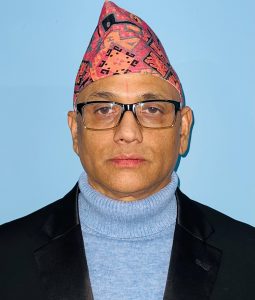
Bishnu Luitel
By Bishnu Luitel & Ganga Lamitaree
“I have repeatedly heard that anti-movement elements are planning to kill me. If my death leads to the establishment of democracy in Bhutan, I am ready to die even at this very moment. But until my last breath, I will continue to struggle for a uniteddemocratic movement.” — R. K. Budhathoki, approximately fifteen minutes before his assassination, September 9, 2001.
Ganga Lamitaree
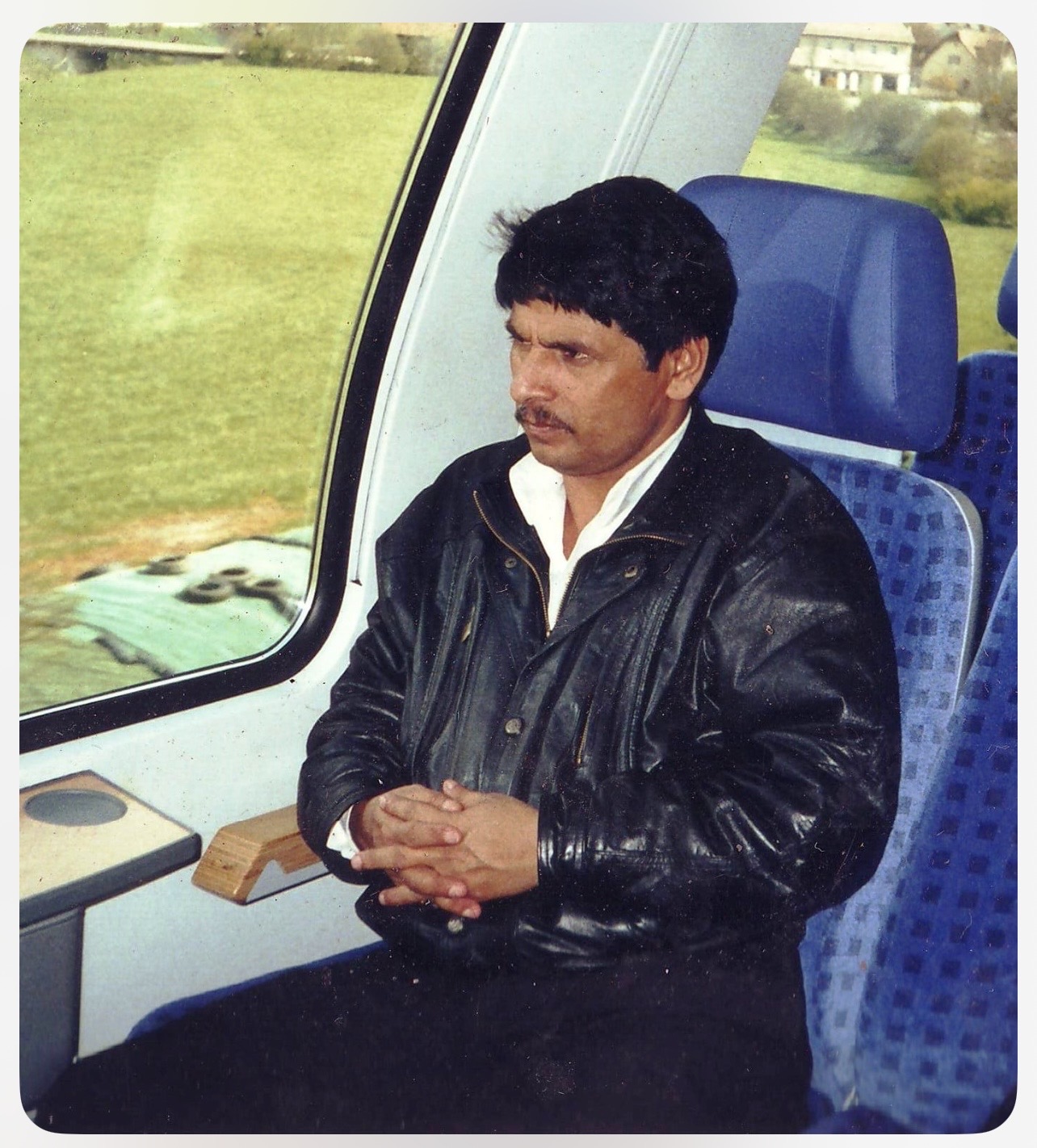
The late Rajkumar (R. K.) Budhathoki was a leading leader who dedicated his life to democracy, human rights, social justice, and national unity in Bhutan. He was born on July 26, 1957, in Bana village of Sibsu Dungkhag, under Samtse Dzongkhag, as the eldest son of the late Tek Bahadur Budhathoki and Harimaya Budhathoki.
Beginning his early education at Bana Primary School, he completed his I.C.S.E (Grade Ten) from Kharbandi Technical School in Phuentsholing, after studying in Gelephu. In 1976, he began government service with the Department of Telecommunications of the Government of Bhutan. He served as a Senior section officer (S.O) at the Vigilance Court and later as an Assistant Director at the Budget Bureau. After pursuing higher education at the University of Pune in India on a government scholarship, he worked as an Assistant Director in the Department of Revenue and Customs. He married Jasoda Kattel (Budhathoki) on February 24, 1978. They have three sons: Akash, Anand, and Ashish.
R. K. Budhathoki was not only a skilled administrator but also a studious and thoughtful person devoted to the search for truth. While studying in India, he was deeply influenced by the principles of the Indian independence movement, democracy, and human rights. The difference between democratic India and the authoritarian rule of Bhutan further sharpened his political consciousness.
Following the amendment of the Citizenship Act in 1985, the increasing discrimination against Nepali-speaking citizens in southern Bhutan, the process of stripping people of citizenship, repression, and expulsion deeply affected him. Rather than remaining a silent witness to injustice while staying within the state machinery, he chose to give up his secure government life and join the struggle for democracy, human rights, and civil liberties. As a result, he was forced to leave his homeland in 1989.
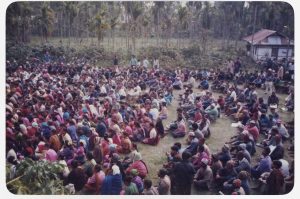
In exile, he played a historic role in organizing the Bhutanese democratic movement. Under his leadership on 2nd June 1990 the Bhutan People’s Party (BPP) was established, and he became its founding chairman. In 1990, he led a peaceful mass movement for democracy and human rights. He was a supporter of a multiparty parliamentary democracy with a constitutional monarchy. For him, democracy was not merely a change of government; it was the foundation for building a nation based on justice, equality, human dignity, and accountability to the people.
Realizing that the growing divisions among various political groups in exile had weakened the movement, he made unity the center of his political campaign. In 1994, demanding the unification of the movement, he undertook a historic 126-hour hunger strike. After that, an environment of cooperation was created among various democratic forces. Through the Bhutanese Coalition for Democratic Movement (BCDM), United Front for Democracy (UFD), and Bhutanese Refugee Representative Repatriation Committee (BRRRC), he continuously worked to unify and make the movement more effective.
Another major objective of his was the safe, dignified, and honorable repatriation of exiled Bhutanese. He opposed the process of arbitrarily and artificially categorizing refugees into various fabricated categories. To gain international support, he traveled to various countries in Asia and Europe. While organizing a voluntary repatriation march from India toward Bhutan, he was arrested several times, but his determination did not weaken.
It seems destiny had reserved the most painful moment for the movement.
At approximately 3:15 p.m. on September 9, 2001, anti-social criminal elements who had entered the refugee camp attacked him with a khukuri in broad daylight while a meeting was being conducted in a hall in Damak, Nepal. Anti-social elements carried out a planned attack and cowardly assassinated him. At that time, he was discussing the refugee verification process and Bhutan–Nepal talks with his colleagues. His assassination was not merely the end of the life of a leader; it was an irreparable loss to the Bhutanese democratic movement.
The Bhutan envisioned by R. K. Budhathoki was a peaceful, democratic, inclusive, just, and prosperous nation. He wanted a country where no one would face discrimination on the basis of caste, language, religion, culture, or region (southern and northern Bhutanese; Dzongkha and Nepali speakers); where every citizen would receive equal rights, opportunities, and respect. He wanted a democratic constitution to become not merely words written on paper but a way of life among the people.
His vision was of a self-reliant Bhutan that had progressed in science, technology, education, research, agriculture, industry, and entrepreneurship. It was a country where young people could see their future in their own homeland, where diverse cultures and languages were respected, and where national interest stood above political competition. He believed in dialogue, tolerance, reconciliation, and national unity rather than violence, hatred, and revenge. In his thinking, regardless of whichever dynasty came to power to govern Bhutan, the highest principle was that Bhutan must remain a sovereign and independent nation.
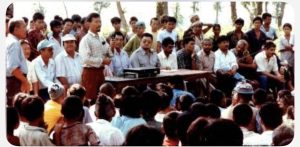
R. K. Budhathoki is not physically among us today, but his ideas, sacrifices, and democratic ideals remain alive. A true tribute to him is not merely to remember him, but to continuously strive to build the just, democratic, and reconciled Bhutan that he envisioned. His life came to an end, but his dreams remain alive, and through those dreams, he will remain immortal in the hearts of the Bhutanese people.
The Thirteen-Point Demands
On behalf of the Bhutan People’s Party (BPP), the late leader R. K. Budhathoki, in his capacity as Chairman of the party, presented the following thirteen-point demands to the King of Bhutan, Jigme Singye Wangchuck, on September 19, 1990:
1. Unconditional release of political prisoners,
2. Changes from absolute monarchy to constitutional monarchy,
3. Reforms in the judiciary,
4. Amendments to the Citizenship Act,
5. Right to culture, dress, language, and script,
6. Freedom of religion,
7. Freedom of the press, speech, and expression,
8. Freedom to form unions, associations, and political parties,
9. Freedom of trade and occupation,
10. Right to equitable distribution of wealth and funds,
11. Right to equality of opportunity in matters of public employment,
12. Right to education,
13. Right against exploitation.
None of the points in the thirteen-point demands of the Bhutanese citizens prepared under the leadership of Budhathoki aimed at the King’s royal throne. The chronic disease that has taken deep roots in Bhutanese politics for centuries is the destruction and physical elimination of the opposition itself. At a time when the awareness among the Bhutanese rulers was almost nonexistent that the opposition has an important role in ensuring that their country does not become anyone’s slave, keeping the country’s borders secure, determining a path of development according to the times, and controlling irregularities, King Jigme Singye Wangchuck considered R. K. Budhathoki and all Bhutanese citizens who supported him to be foreigners and terrorists.
Today, leader Budhathoki is no longer physically among the Bhutanese people who have been victimized by the Government of Bhutan. Knowing the basic democratic principle that the main link of a sustainable system of governance is that the government belongs to the ruling side and the parliament belongs to the opposition is a matter of minimum awareness for a people-oriented leader. Although this understanding is still not found among the Bhutanese rulers, he considers himself a champion of democracy.
Time is powerful, and time itself teaches everyone its lessons. The downfall of unreasonable and misguided elements is certain. The highest thoughts of leader Budhathoki and the Bhutanese citizens, and their firm positions that the indispensable principles of human civilization and the modern paths of the way of life will always remain relevant to the times, will continue to remind the Bhutanese rulers forever.
We offer our heartfelt tribute to Bhutanese democratic leader Mr. Budhathoki.
Special thanks to Balaram Poudel and Deo Maya Giri for their valuable support in providing the photographs and materials used in preparing this biography.
Support the New Americans magazine to continue to serve our community with precise news that affect the new American, immigrant and refugee community. https://paypal.com/donate/?hosted_button_id=8LHFS78NRNJJY&source=url