 By
By In Gahanna, a Mile of Gold for Children With Cancer
An African-led community gathering paired a wooded walk with storytelling, fundraising and a reminder that support does not always end in a cure, but can still leave a family with dignity, assurance and hope.
The path was still damp and scattered with early fallen leaves when the walkers came through in navy-blue shirts. Some moved in pairs; others kept pace in a loose cluster. A small child rode on an adult’s shoulders. Their shirts carried a declaration, “3 Years Strong”, alongside the gold ribbon that has become the emblem of childhood cancer awareness. It was a modest procession, not a race and not a spectacle.
But on Saturday, September 5, 2026, at the Gahanna Municipal Golf Course, the walk gave physical form to a burden that families often carry privately: the fear, disruption and cost that follow a childhood cancer diagnosis. Organised by N’Daye Fatou Foundation Inc. under the theme, “Let’s Paint a Mile With Gold,” the programme commenced at about 11 a.m. with the walk. The route included two carefully planned stops. At each one, walkers encountered the photograph of a child whom the not-for-profit organisation had supported. The images gave names and faces to a cause that can too easily be reduced to ribbons, statistics and fundraising appeals.
One station featured Mohamed Camara. Another featured Oumou Diallo, smiling in a brightly patterned dress beside an arrangement of fruits and vegetables. It was at Oumou’s station that the walk’s most affecting story was told. Aminatu Camara, founder of N’Daye Fatou Foundation Inc., told the gathering that Oumou had died from cancer despite the medical assistance and resources the organisation mobilised on her behalf. The outcome was devastating. Yet, according to Kamara, Oumou’s parents remained grateful for the support their daughter received. Without that intervention, the family might have been left believing that Oumou died simply because they did not have enough money to secure appropriate medical care.
The foundation’s assistance gave them the assurance that everything reasonably possible had been done for their daughter. They could mourn without also carrying the tormenting belief that poverty alone had determined her fate. Kamara said the family came to understand Oumou’s life through a deeper spiritual conviction: that she had come for a purpose and, despite every effort made to save her, it was her time to go. The account moved those gathered around the child’s photograph. It also complicated the conventional meaning of success in charitable work. Success is not always a child who recovers.
Sometimes, even after considerable resources have been mobilised and the best available care has been pursued, a child still dies. In such circumstances, the intervention has not necessarily been without value. It may have given the child care and dignity. It may have spared the family from helplessness and isolation. It may have replaced a lifetime of unanswered questions with the knowledge that their child was not abandoned and that every possible effort was made. Sometimes, the outcome is healing. Sometimes, it is succour. Sometimes, it is the presence of a community refusing to allow a family to confront illness, loss and grief alone. The walk continued after that stop, but the meaning of the journey had changed. Childhood cancer was no longer an abstract cause represented by a gold ribbon. It had become the story of a child, a family, a community’s intervention and a loss that medical care and goodwill could not reverse.
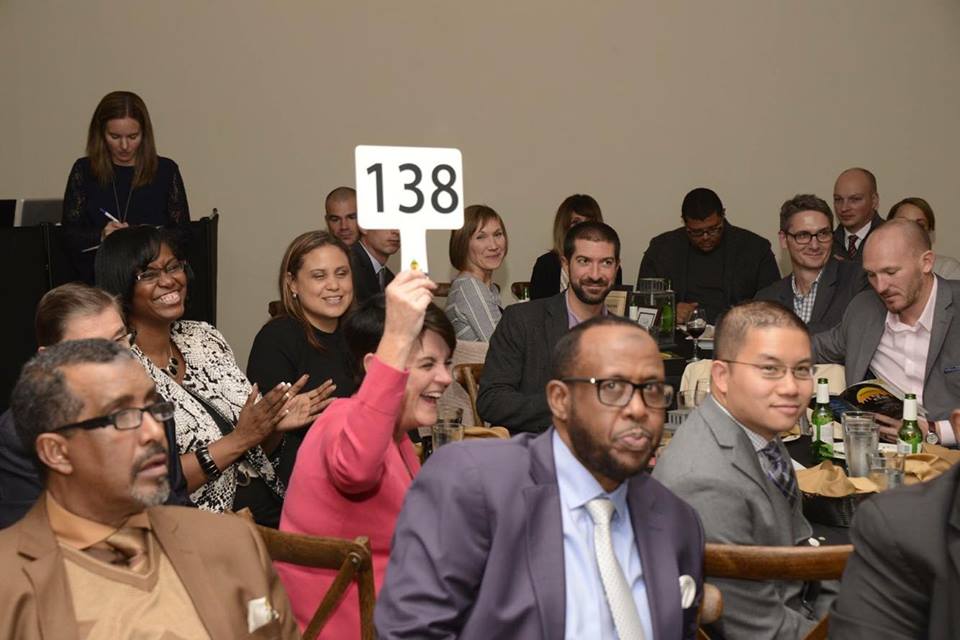
After completing the walk, participants moved indoors into a wood-beamed hall decorated with black-and-gold balloons. Families, community leaders and other guests gathered around tables for the second phase of the programme, which included presentations, a raffle draw, fundraising, food and gifts. The transition from the walking trail to the indoor gathering reflected the two dimensions of the occasion. The walk made the cause visible.
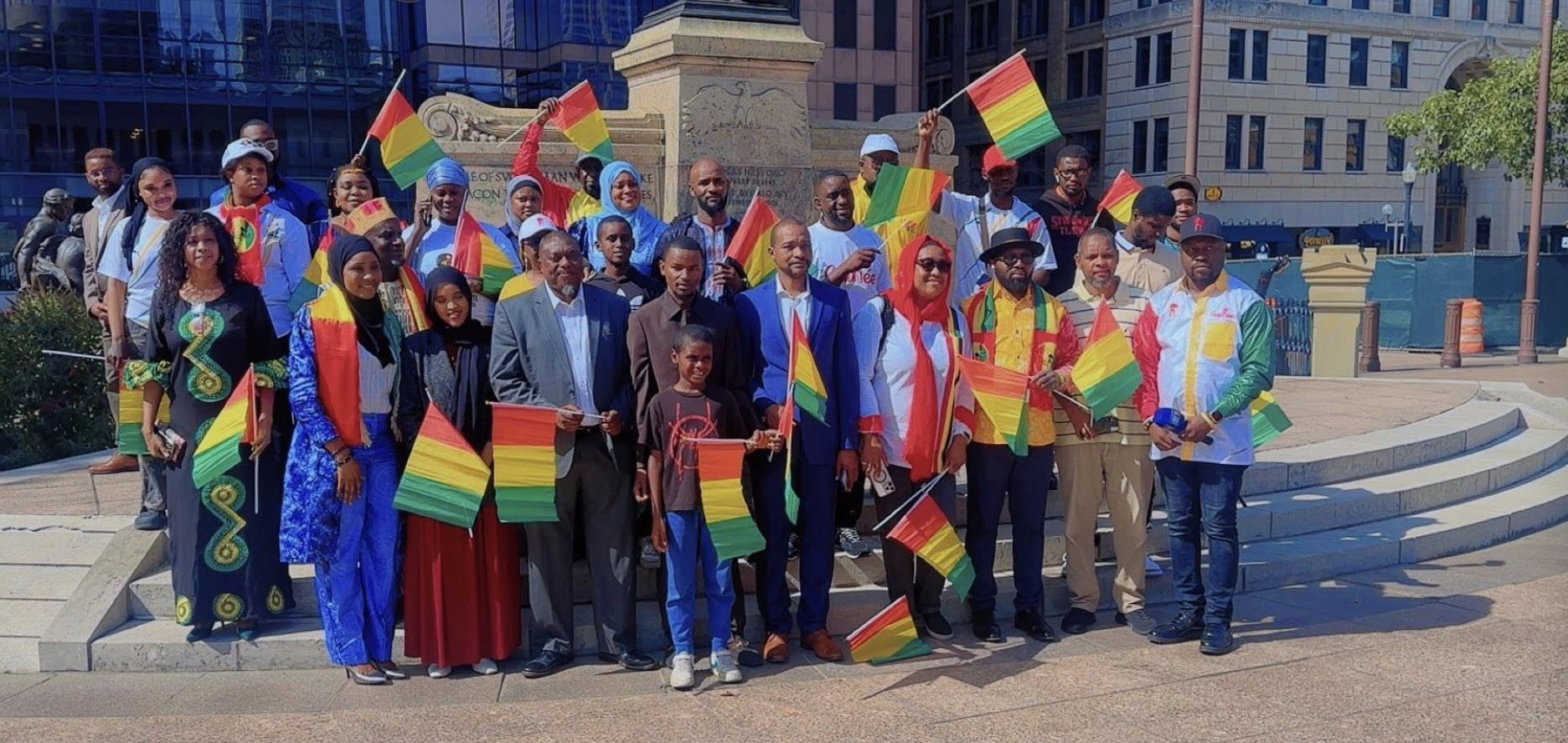
The indoor programme created room for conversation, community participation and practical support. One of the event’s most distinctive features was the breadth of the community assembled around it. Representatives connected to Guinea, Senegal, Malawi, Liberia, Nigeria and Côte d’Ivoire participated in the programme, a gathering rooted in Columbus but unmistakably shaped by the city’s African immigrant communities. Amadou Sow represented Guinea; Awa Kodia represented Senegal; Brains Banda represented Malawi; Facia Hilton represented Liberia; Taiwo Akinlami represented Nigeria; and Viviane represented Côte d’Ivoire.
The programme also featured guest speakers and community leaders drawn from civic engagement, immigrant-community advocacy, enterprise and community-based support. They included Mrs. Feyi Tolani, Founder, Felbry College of Nursing; Deba Uwadiae of New Americans Magazine; Mr. Sall Doudou of Prosperity Care Services LLC; Cecilia Daillo of She Ready Movement; and Mrs. Hannah Joseph of the Mende Descendants Union of Ohio. Together, the participants represented more than a collection of organisations and nationalities. Their presence placed childhood cancer before the community as a shared civic and human concern. The roll call mattered.
In a room marked by small national flags and multiple identities, childhood cancer was presented not as somebody else’s private tragedy, but as a responsibility capable of crossing nationality, language, culture and faith. Cancer in children is rare compared with cancer in adults, but its consequences are severe. The United States National Cancer Institute says cancer remains the leading cause of death from disease among American children, even after the childhood cancer death rate fell by 70 percent between 1970 and 2020. In 2025, the institute estimated that 9,550 children from birth through age 14 would be diagnosed with cancer in the United States and about 1,050 would die.
The progress behind those numbers is real, but it is not evenly shared. A diagnosis may arrive in a household as a medical emergency, yet quickly become a family-system crisis. Parents’ work schedules change. Siblings may receive less attention. Transportation and housing become harder to manage. Ordinary bills continue while hospital appointments and treatment take over the family calendar.
For immigrant families, those pressures may be compounded by unfamiliar institutions, limited support networks or language barriers. That is where a local gathering can have value beyond its size. An awareness walk does not treat disease, and a community fundraiser cannot substitute for accessible specialist care. What such programmes can do is make the burden visible, connect families to people who may help and turn sympathy into organised support. The raffle draw and fundraising brought that practical dimension into the gathering. They invited those present to move beyond recognition of the gold ribbon and contribute to the work surrounding the cause. Inside the hall, the visual language remained deliberately simple. Gold ribbons appeared on balloons and the event backdrop.
Participants’ shirts used the language of strength. Children were present among the adults. Food, conversation, gifts and the raffle draw brought warmth to the occasion without obscuring the seriousness of its purpose. There was also a quiet contrast between the wooded path and the indoor programme. Outside, people moved forward together. Inside, they sat face to face. The first gesture suggested endurance; the second, community. Both are needed when serious illness enters a family.
By midafternoon, the walk had ended, the stories had been told and the tables had begun to clear. The gold ribbons remained overhead, symbols of an awareness campaign observed throughout September, and of family journeys that do not end when a programme does. In Gahanna, the message of the day was carried first by feet on a shaded path, then by a mother’s account of a child who could not be saved, and finally by voices around crowded tables: No family should be left to make that journey alone.
Support the New Americans magazine to continue to serve our community with precise news that affect the new American, immigrant and refugee community. https://paypal.com/donate/?hosted_button_id=8LHFS78NRNJJY&source=url

Screenshot