 By
By 
Bishnu Luitel
By Bishnu Luitel, Harrisburg, Pennsylvania
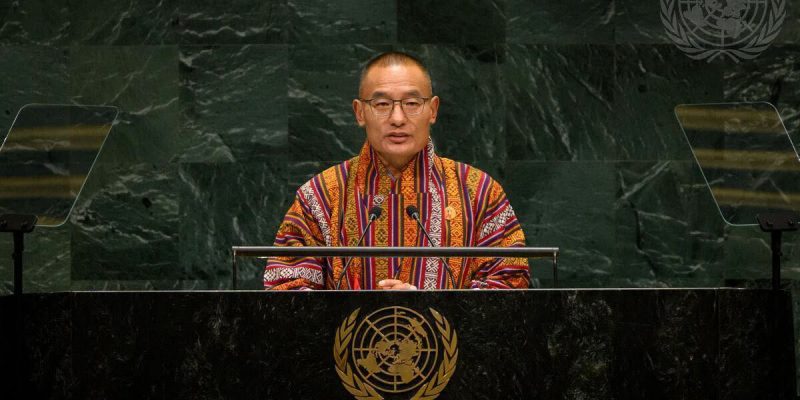
Bhutanese Prime Minister Tshering Tobgay recently presented Gelephu Mindfulness City (GMC) at the 81st United Nations General Assembly on human rights as an ambitious project for Bhutan’s future. In his address, he described GMC as an “institutional blank sheet”—where Bhutan can build new laws, institutions, businesses, technology and infrastructure from the beginning. The assembly was held in New York, United States, from September 22 to 26, 2026. Various important questions were overshadowed in the presentation made by the Bhutanese Prime Minister at the General Assembly.
GMC may be a new beginning institutionally, but that land is not a blank sheet. People were already living there. Even today, a small number of people continue to live there. There are farmers. There are families. There are communities. People’s homes, land, livelihoods and history are connected to that very land. The fact that the current development is affecting those people has also been publicly emerging and continues to do so.
According to Bhutan’s own report, the Gelephu International Airport project is affecting hundreds of landowners. According to a report by Bhutan Broadcasting Service (BBS), 552 landowners in Samtenling (Bhur Block) Gewog have been affected, and approximately 1,400 acres of land are being affected by it. It has been reported that affected people have been offered options such as replacement land, tokenization or financial compensation.
The above report by BBS also raises a question among citizens inside and outside Bhutan and the international community: What will happen to the future of people who have been living in that area from before?
The land affected by the Gelephu Mindfulness City project was not and is not a blank sheet. During the human rights and democratic movement in Bhutan in the 1990s, the government imposed military rule in the country to suppress the people’s voices. Bhur Block (today’s Samtenling); Chwabarri (today’s Jigmeling) (part of this location falls within the airport); Gelephu Block; Danabari Block (today’s Chuzagang); Lalai Block (today’s Umling); Taklai Block (today’s Tarithang); and Sure Block (today’s Jigmichholing) were all densely populated places. After Bhutan expelled the citizens of those places from the country by imposing military rule, it even changed the names of those places. The main reason Bhutan changed the names of those places was to erase from the records the history of the people who had lived there for generations and who were the rightful owners of the land.
Prime Minister Tshering placed considerable emphasis on nature conservation in his address.
He discussed forests, rivers, elephants, tigers, biodiversity and Bhutan’s carbon-negative target. He said that GMC would be “built within it” without destroying the environment.
Environmental protection is an important issue. But in the name of environmental protection, expelling people living there from the country by using the army, taking away their land, depriving them of their fundamental rights and even making them stateless is also a matter of shame for a state.
It is necessary to protect wildlife and forests, but the communities living there cannot be ignored in their name. Likewise, simply providing financial compensation in a major development project does not automatically make that project just.
According to the grievances of those affected, they have to pay the bank installment every month for a piece of land accumulated through hardship, but they are not allowed to build a house on it.
Bhutan expelled most of the citizens from there and did not provide compensation for the land and property even to those who remained. By telling them that after the completion of the GMC construction, the value of the entire city would be determined and they would be given a share in it, Bhutan has deceived its citizens in a hundred-year project through an illusion and magical maneuver, leaving citizens to live in hope until the end of their lives without receiving any compensation.
The question is not only how much money was given in compensation. These questions also arise—
How will they maintain their livelihoods? Is the alternative land provided actually equivalent? Can families continue to live in their own communities or not? Is the valuation of the land fair and independent? Can affected people effectively file complaints or legally challenge the government’s decision?
These are not ordinary questions. These are fundamental rights questions in any major development project. But because of Bhutan’s history, these questions become even more serious in the case of Gelephu.
The history of southern Bhutan cannot be separated from the debate on modern development. In the 1990s, more than one hundred thousand Nepali-speaking Bhutanese were displaced and eventually became refugees in Nepal. UNHCR has documented the large-scale expulsion of citizens from Bhutan. At the same time, the position of the Bhutanese government is also documented—the government claimed that many of them were not legitimate Bhutanese citizens or that they had voluntarily left the country. The refugees and their supporters, however, rejected this claim and said that they had been forcibly expelled from the country. Of those more than one hundred thousand refugees, approximately forty to forty-five thousand Bhutanese citizens were expelled from only the area of the Gelephu modern city, GMC, which Bhutan now says it is going to build.
This history remains an unresolved issue for many Bhutanese citizens and other stakeholders even today. If the government is moving forward with one of the largest development projects in its modern history in southern Bhutan itself, it is also Bhutan’s responsibility to demonstrate that the displacements, injustices and unresolved questions of the past will not be repeated in another form.
If Bhutan was going to build a modern city in the Gelephu area itself, why did it not choose uninhabited vacant land? The vacant land to the north of the Gelephu Mindfulness City that Bhutan has now chosen is a wider and more suitable area than the area envisioned for the present modern city. From that large and vast plain stretching from Ramite Dada in the southwest to Pokhari Dada in the northeast, how broad a modern city would have been possible if the Mindfulness City had extended eastward from Chamling, Thulo Khaling to Jhande Dada?
Roads would also have expanded. An express road would have provided tourists with a new and enjoyable destination up to Mans Glacier. The enjoyment of a cable car from the flat lands above Madhu Bhir and Jayanti Bhir to Torme Dada would have been something else altogether. Who would not have enjoyed the taste of Santola blinking in the depths of Rang Khola through an express road from Ramite and Pokhari Dada to Rang Khola? Who would not be attracted by the natural beauty of Tin Kune, Lam and Nil Pokhari? How effective would hiking from Gelephu to the Black Mountain have been? But this is glaring evidence that the Bhutan government’s current GMC project was only intended to expel Nepali-speaking Bhutanese from that area.
There must be a clear policy on how land is acquired, and landowners must be clearly informed about that policy. There should be a provision to independently agree or disagree with the valuation determined by the government.
There must be a clear plan for how affected farmers will maintain their livelihoods. Until the modern city is constructed, the government must take responsibility for the food, shelter and clothing of the affected people. The citizens there must also be allowed to raise even the most uncomfortable questions.
In this regard, what did Prime Minister Tshering say at the United Nations General Assembly about the status of historical land and property claims related to people displaced from southern Bhutan? Can a new city erase the history of any minority citizens of the country?
The language used by Bhutanese Prime Minister Tshering while presenting GMC is highly ambitious. He presented GMC as a place where capitalism and human welfare would move forward together. He said artificial intelligence and Buddhism would coexist, and that economic development and nature conservation would move forward simultaneously.
But here, an important contradiction needs to be questioned.
Can a development project that places human welfare at its center regard the people already living there and the citizens expelled by the state in 1990 merely as another problem that needs to be managed? Where and how have the citizens displaced by the international airport currently under construction in GMC been managed? Does Bhutan have freedom of speech and press freedom for citizens to raise these and countless similar questions before the government?
The Prime Minister has called GMC a project for the children and future generations of Bhutan. Then another question arises: Whose future? The future of international investors? The future of technology companies? The future of wealthy and skilled people who will move to Gelephu? The future of tourists and spiritual visitors? Or also the future of the farmers and families who are already living there?
If GMC is truly a project that will transform Bhutan, why should the people there be confined only to a situation where they must leave their land and necessarily adjust to a new economic system to be built in the future? What is preventing the government from compensating them for their land and making other land available to them at an affordable rate, freely?
Why does the government give the same vague answer to this—“It cannot be done.” Why?
Imagine—a farmer loses land that his family has cultivated for generations, and the government gives him money for it. For the government, that may be compensation. But that does not guarantee that the farmer’s life will be fully restored. The Bhutanese government cannot simply compensate the people within the GMC project. It must also guarantee the future of them and their children. It must assure its citizens that the government is present for them. It has been a long time since the Bhutanese government has been repeating the GMC slogan. But how many ordinary people have received employment as of now or to this day? How many young people who had received higher and technical education and had gone to Australia, Europe, Canada and America have returned after getting employment in GMC? If employment has not opened up for them in GMC and GMC does not provide employment for ordinary people, Bhutan must clearly say for whom this project is being built. If ordinary Bhutanese cannot obtain employment in that project, how will they benefit from GMC? Simply increasing the tax rate on people living within the GMC project area and adding burden upon burden is not what makes a modern city. The Prime Minister has called GMC a project for the children and future generations of Bhutan.
There were six schools in the blocks considered the heart of GMC where military barracks were established in 1990—Phur Primary, Lodrai Primary, Gelephu Junior High School, Norbuling Primary, Lalai Primary and Taklai Primary. If, as Prime Minister Tshering said at the United Nations General Assembly, this is a “project for the children and future generations of Bhutan,” then the Prime Minister should be able to show at which of the above-mentioned schools a model modern education system was started.
According to informed sources, among those schools that had been turned into army barracks since 1990, Gelephu Junior High School has now been upgraded to a high school and provides education up to Grade 12, while the other five schools were closed. Here again the question arises: until 1990, between 500 and 700 students were studying at each of those five schools. Where are the approximately 3,500 to 4,000 students and their parents who were studying in those schools today? What greater evidence does the international community need than this that the Bhutanese government expelled its own citizens by making them stateless?
Another issue is: At what time and in which century did Bhutan provide education to so many children of citizens of other countries, such that when those non-citizens were expelled from the country, nearly four thousand students in the same GMC area and five schools had to be closed? At which United Nations assembly did the kings and prime ministers register the issue that foreigners had encroached upon the GMC area of Bhutan?
If, after the Bhutanese government introduced the GMC project, those lands were encroached upon by Lhotshampas, then when did the GMC project begin? If the conceptualizer of this project was indeed the Fourth King Jigme Singye Wangchuck, then those people who were expelled from Gelephu had already been living there before Bhutan’s hereditary first Maharaja, Sir Ugyen Wangchuck, became king. To put it another way, at that time the name of Gelephu was Hatisar. That Hatisar was taken away by the British East India Company government in 1865 under the name of the Treaty of Sinchula. That area is known as the Assam Duars. After that, the land north of Hatisar began to be called Gelephu on the Bhutan side. Hatisar was merged into the Assam province of India. At that time, eighteen locations in southern Bhutan along the northern borders of Assam and West Bengal, the India-Bhutan gateways, were incorporated into India.
Likewise, which health post was upgraded to a level suitable for GMC? Bhutan has presented GMC to the world as a new model city for its future? Wherever there were primary schools, there were also Primary Health Units (BHUs). Gelephu General Hospital is still in the same condition today as it was in the 1990s.
Before the world’s wealthy countries, companies and individuals pour their investments into GMC, should Bhutan’s success not be measured on the basis of how Bhutan treated and is treating the people who were already living there before its foundation was laid? When the United Nations itself brings out the reality of Bhutanese who have been living a hellish life for thirty-five years in refugee camps in Nepal and Bhutanese resettled in other third countries, what image will Bhutan’s GMC have in the eyes of the world? What view will the world have of Bhutan, the cruel monarchy that in the 1990s brutally expelled more than one hundred thousand of its own citizens from the country by labeling them non-citizens and terrorists, and of those who today call themselves messiahs of democracy while becoming richer by investing in the blood, sweat, bloodshed and ashes of those same expelled Bhutanese?
The Bhutanese government is presenting Gelephu Mindfulness City to the world as a model of economic prosperity, modern technology, clean energy, biodiversity and spirituality. The Prime Minister himself, calling himself a “salesman” at the United Nations General Assembly, has invited foreign investors, companies and entrepreneurs to invest in Bhutan. But the success of any major development project is not limited only to investment and infrastructure construction. The impact that the project has on the lives of affected local citizens is equally important. The question of how the land required for the construction of GMC is acquired is particularly important. It must be clear what impact losing their land has on local residents’ agriculture, livelihoods and social relationships.
An answer is also necessary to the question of what happens if the alternative land provided by the government is not equivalent to the old land. If there is disagreement over land valuation, citizens must have access to fair hearings and justice. Most importantly, it must be clear how the rights of a citizen are protected if that citizen does not want to sell their land, while another person does want to sell. Local people should not be displaced against their will in the name of development. Simply trusting that the government will make the right decision is not enough. Independent and effective judicial and communication institutions through which citizens can protect their rights are also necessary.
If the government considers GMC a model of modern governance with an independent judiciary, predictable laws and strong institutions, those commitments must also be demonstrated in practice. Affected families must be provided with proper compensation, transparent procedures and access to independent judicial remedies. Clear information about historical land claims and the rights of local communities must also be made public. While attracting investors, not only the opportunities created by the project but also the social and human challenges that may arise from it must be presented to the world. Along with the hope of creating new employment, the possibility of destroying old sources of livelihood must also be considered.
In this context, the question of what lessons Bhutan has learned from the displacement crisis of the 1990s is important. A new development story cannot be complete by ignoring past events. “Mindfulness” should not be limited only to forests, buildings, technology and spirituality; it also means being conscious of people’s lives, rights and dignity. Genuine development must acknowledge the history of the land and respect the identity and rights of communities that have been living there from before. The success of GMC should not be measured only by foreign investment, gross domestic product, technology companies or the number of magnificent buildings. Its evaluation should also be based on whether affected citizens have actually received justice, security, dignity and the real right to make decisions about their future.
If Bhutan wants to make GMC a new model for the future, it must ensure the consent, transparency and justice of local people at its foundation. Even if a new chapter can be started institutionally, human history cannot be made into a blank sheet. To prove that Bhutan is indeed as flawless, clean and impartial in the context of GMC as it has explained to the world so far, an independent court must be established at the heart of Gelephu Mindfulness City. A judicial body of the United Nations should be involved in that court, and Bhutanese refugees currently in Nepal and Bhutanese resettled in third countries should be allowed to submit claims with evidence of their respective lands and properties. In that court, not only Bhutanese but also Indians should be allowed to present evidence of how the Indian government loaded the people expelled by Bhutan in the 1990s into trucks at the Bhutan-India border and drove them toward Nepal, beating them with sticks at night through Kakarbhitta, the eastern border crossing between Nepal and India. Human rights activists, civil society members, journalists, local leaders and ordinary affected people there should also be able to submit evidence-based statements.
Bhutan must build the future of “GMC” and “Gross National Happiness” through repentance for its past mistakes and respect for the rights of its citizens. Those whom the Bhutanese government expelled in the 1990s by accusing them of treason and “Ngolop” are also Bhutanese citizens. The displaced citizens have also accused the government of creating stateless people by unleashing state terror. In this, time will certainly weigh, on the scales of the future, the percentage of responsibility for merits and faults between the Bhutanese government and its citizens.
Support the New Americans magazine to continue to serve our community with precise news that affect the new American, immigrant and refugee community. https://paypal.com/donate/?hosted_button_id=8LHFS78NRNJJY&source=url






Screenshot