 By
By By Okon Ekpenyong
For Jay and Cassie Zurlinden, the fight to save their son, Jayden, became a fight for other families across Ohio.
The West Chester couple spent years navigating a complicated medical system after Jayden received a cancer diagnosis as a toddler: a rare perianal rhabdomyosarcoma. After extensive treatment, surgeries, and radiation, he went into remission. Years later, while attending Lakota Local School District schools, his cancer returned as Stage 4 radiation-induced osteosarcoma.
From Jayden’s first diagnosis, his parents rallied community support throughout his illness, organizing “Cards For Cancer” drives and pediatric cancer fundraisers and advocating for access to clinical trials.
Cards for Cancer is an initiative that collects sports trading cards—featuring some of the biggest names in baseball and other sports—to give to young cancer patients. For these children, receiving a card from a favorite athlete can create a lasting memory long after their treatment.
Along the way, they met many families facing similar challenges, making their fight bigger than their own. Before his death, Jayden wrestled on his high school team, learned to play guitar, and continued fighting until the end. He died in June 2026 at age 20. But his parents decided their advocacy would not end with his death.
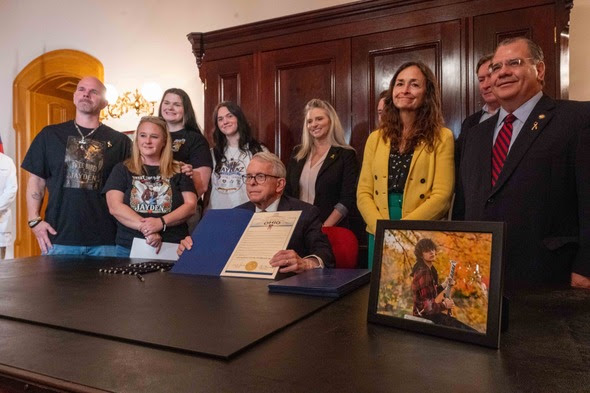
“We could have easily stopped fighting when our son passed away,” Jay said during a Statehouse news conference Tuesday. “But we made a promise to him. We will never stop fighting—not just for our son, but for all the children and families out there.”
That promise helped bring the family’s experience to Gov. Mike DeWine’s attention.
DeWine said Jay and Cassie asked to meet with him, and his first response was to determine how the state could help. He brought in Ohio Department of Health Director Bruce Vanderhoff and members of his cabinet to discuss the family’s concerns. But DeWine said the conversation quickly revealed a larger issue.
“If a very motivated family, Jay and Cassie, who did everything they could to save their son, were having trouble navigating the whole system,” DeWine said, “clearly we must have many, many other people” facing similar challenges.
That realization helped lead to Ohio’s new Pediatric Complex Care Navigation Program, announced Tuesday by DeWine and Vanderhoff.
The program builds on the Ohio Department of Health’s existing Complex Medical Care program and provides specialized navigators to help families dealing with complex medical conditions, including pediatric cancer.
Navigators will help families work through healthcare, insurance, government programs, nonprofit resources, and other logistical challenges.
Instead of simply giving parents a list of phone numbers and asking them to figure out where to start, navigators will serve as direct points of contact who can identify gaps, address roadblocks, and connect families with appropriate resources.
Vanderhoff said the program will provide additional support through an improved navigation process rather than replace resources already available through Ohio’s pediatric hospitals and care teams. In many cases, healthcare providers will refer families to a navigator when the family and care team determine that additional assistance is necessary.
DeWine and Vanderhoff said the state plans to hire a program supervisor and an additional navigator in the coming months. Because the program builds on existing resources and infrastructure, officials said the incremental cost will be relatively modest.
The program also forms part of a broader state effort to address pediatric cancer. Ohio previously announced a $5 million investment in pediatric cancer research.
For Jay, however, the state’s efforts represent more than programs and funding. They represent a chance to give children and families more time and ensure parents do not have to face the system alone.
“Trust me when I say these children need our help now more than ever,” Jay said. “They say Ohio is the heartbeat of America. It’s time for our heart to keep pumping for these children.”
Jay said Ohio now has an opportunity to lead.“We have an opportunity to be trailblazers,” he said.
“We have an opportunity to make a difference, set a standard and establish a precedent for people across the country to stand up with us and say, ‘Enough is enough.’”
For the Zurlindens, the fight continues in Jayden’s memory—and for the children who will face a cancer diagnosis in the future.
“Every child deserves more time,” Jay said. “Enough is enough, he repeated.
Support the New Americans magazine to continue to serve our community with precise news that affects the new American, immigrant and refugee community. https://paypal.com/donate/? Dr;/.hosted_button_id=8LHFS78NRNJJY&source=url






Screenshot