 By
By - Vaccinated individuals at very low risk
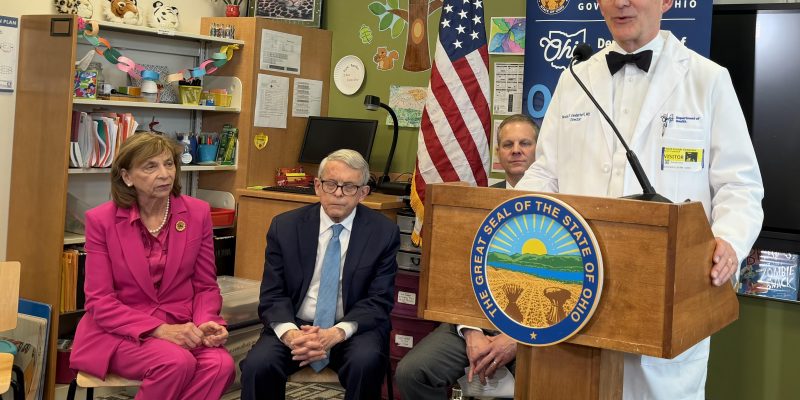
Ohio Department of Health (ODH) Director Bruce Vanderhoff, MD, MBA, has announced that ODH is informing individuals that they may have been exposed to measles at the John Glenn International Airport, Columbus on February 18, 2026, between 6 p.m. and 9 p.m.
Those who were at John Glenn International Airport during that time and who are vaccinated have a very low risk of getting sick. The measles, mumps, and rubella (MMR) vaccine is very safe and effective. Two doses of MMR is 97% effective against measles.
Those who were at the airport during the date and time above who are not vaccinated should be very careful in watching for any signs and symptoms from now through March 11.
If you develop symptoms, immediately stay home and away from others and call your healthcare provider. Tell your provider that you may have been exposed to measles so they can take precautions to avoid exposing others when you arrive for your appointment.
ODH is working with the Centers for Disease Control and Prevention (CDC) and other state and local health officials to identify people who might have been exposed, including contacting potentially exposed passengers on specific flights.
Since the start of February, there have been six cases of measles identified in Franklin County: all in children.
Five are associated with an outbreak. Those five are from two households. There has been no specifically identified travel in those five cases, though there is potential that members of the community may have traveled to an area with an active outbreak.
The sixth case is the case involved in the potential exposure at John Glenn International Airport. That involves international travel and is not associated with the outbreak.
Five of the six children were unvaccinated, and one child had received only one dose of the MMR vaccine. The Franklin County cases are not linked to the outbreak in Cuyahoga County that the department reported in January 2026.
“These most recent cases highlight the critical importance of everyone being up to date with their vaccines, due to the risk of potential exposure anytime we are in large, indoor public venues, such as airports,” Dr. Vanderhoff said. “Measles can be very serious for children, and it is preventable. The vaccine can keep your child from getting this disease.”
Measles is extremely contagious and can live for up to two hours in air where an infected person coughed or sneezed.
Measles symptoms include a rash, high fever, runny nose, cough, loss of appetite and red, watery eyes. The rash usually lasts five to six days and begins at the hairline, moves to the face and upper neck, and proceeds down the body. Diarrhea and ear infections are common complications of measles. More severe complications may also occur.
Complications from measles are more common among children younger than 5 years of age, adults older than 65 years of age, pregnant women, and people with compromised immune systems. As many as one out of every 20 children with measles gets pneumonia, the most common cause of death from measles in young children.
The CDC recommends all children get two doses of MMR vaccine, starting with the first dose at 12 through 15 months of age, and the second dose at 4 through 6 years of age. MMR vaccine can also be given to adults who are not vaccinated or whose vaccination status is unknown. Adults who are concerned that they may not be fully protected should talk to their provider.
Ohio has now had nine measles cases in 2026. The state had 45 cases of measles in 2025.
Support the New Americans magazine to continue to serve our community with precise news that affect the new American, immigrant and refugee community. https://paypal.com/donate/?hosted_button_id=8LHFS78NRNJJY&source=url