 By
By 
By Peaches M. Calhoun
Engines argue at intersections. Phones vibrate like anxious thoughts. Voices sharpen under pressure, impatience, and the weight of unfinished days. Politicians shout past one another, volumes turned high while citizens carry the bruises of the decisions left behind—tired bodies, stretched budgets, lives lived in the aftermath. News alerts clamor for attention, each headline louder than the last, while social media fights to hijack the direction of our gaze, pulling the rainbow of irises this way and that, never letting them rest. Schools brace. Jobs disappear. Nonprofits reach farther with fewer hands. Tears fall quietly in cars and kitchens. Doctors do what they can with what they have. Text reminders ping. Calendars warn. Deadlines multiply. Noise becomes the background music of productivity, and chaos learns—convincingly—how to pass for normal.
This is the soundscape of modern America.
And then—without announcement, without amplification—something enters that refuses to compete.
Stillness.
Not the kind that retreats.
The kind that walks directly into the middle of it.
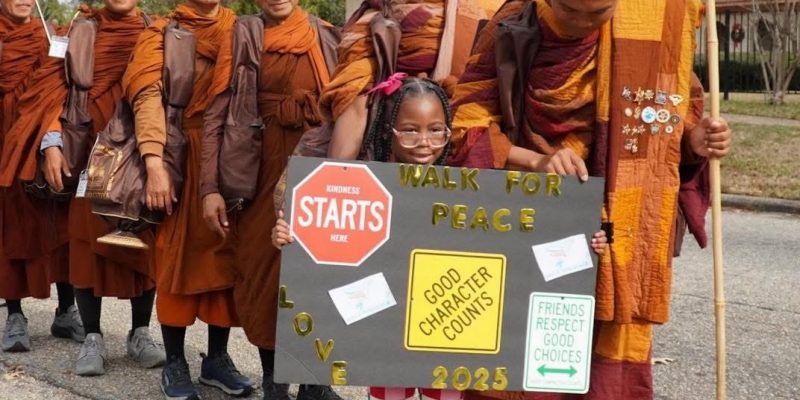
Monks belonging to Huong Dao Vipassana Bhavana Center, based in Fort Worth, Texas are the ushers of such peace . In the fall of 2025, roughly two dozen monks began a pilgrimage on foot across the United States—more than 2,300 miles, from Texas to Washington, D.C.—with a single intention: to cultivate peace and compassion through presence rather than persuasion.
They walked along highways and back roads, through small towns and major cities, stopping wherever the road and the people allowed. They did not carry political messages. They did not endorse candidates or policies. Their method was older and far more difficult: embodied discipline.
About a month into the journey, the cost of that discipline became visible. While walking along a Texas roadway, a vehicle struck their escort car. Several monks were injured. One monk, Maha Dam Phommasan, suffered injuries so severe that his leg ultimately had to be amputated.
The walk did not end.
After recovery and regrouping, the monks resumed their pilgrimage—publicly dedicating the injury not to anger or blame, but to the very practice they were undertaking. For many who encountered them afterward, this moment reframed the entire journey. The walk was no longer symbolic. It was consequential.
As they moved eastward, communities responded.
Local residents brought water, food, and shelter. Faith leaders and civic officials met them without fanfare. Police departments adjusted traffic patterns to ensure their safety. Cities issued proclamations recognizing the walk—not as protest, but as public service. In multiple towns, spontaneous vigils formed. People prayed, sat quietly, or simply stood together.
The monks’ canine companion, Aloka, became a familiar and grounding presence—reminding onlookers that care extends beyond words, beyond humans, beyond ideology.
By the time the group approached the nation’s capital, the impact was already measurable—not in legislation passed or slogans shared, but in moments interrupted. In people who slowed down. In conversations that didn’t escalate. In spaces where listening replaced positioning.
Up close, the monks’ robes tell the story the headlines cannot. Pins mark cities passed through, communities encountered, hands shaken. Not trophies—evidence. Proof that gentleness, repeated mile after mile, leaves a record.
At stops along the way, monks spoke briefly, often with eyes closed and palms pressed together. They did not argue for peace. They practiced it publicly and allowed silence to finish the thought.
And then, as all storms do, they moved on.
What remains is not spectacle.
It is a recalibration.
The noise did not disappear. It never does. But for a stretch of road, a series of towns, a collection of people who were there that day—the volume changed.
Stillness entered the noise.
And it proved that peace doesn’t need a microphone to make a megaphonic impact.
Support the New Americans magazine to continue to serve our community with precise news that affect the new American, immigrant and refugee community. https://paypal.com/donate/?hosted_button_id=8LHFS78NRNJJY&source=url